Now
I am a Staff Mechanical Design Engineer at Tesla, where I lead the team responsible for chassis structures across every vehicle program. I joined as an intern in 2016, went full time in 2017, made senior in 2019 and staff in 2021, and have been leading people as well as engineering since late 2023.
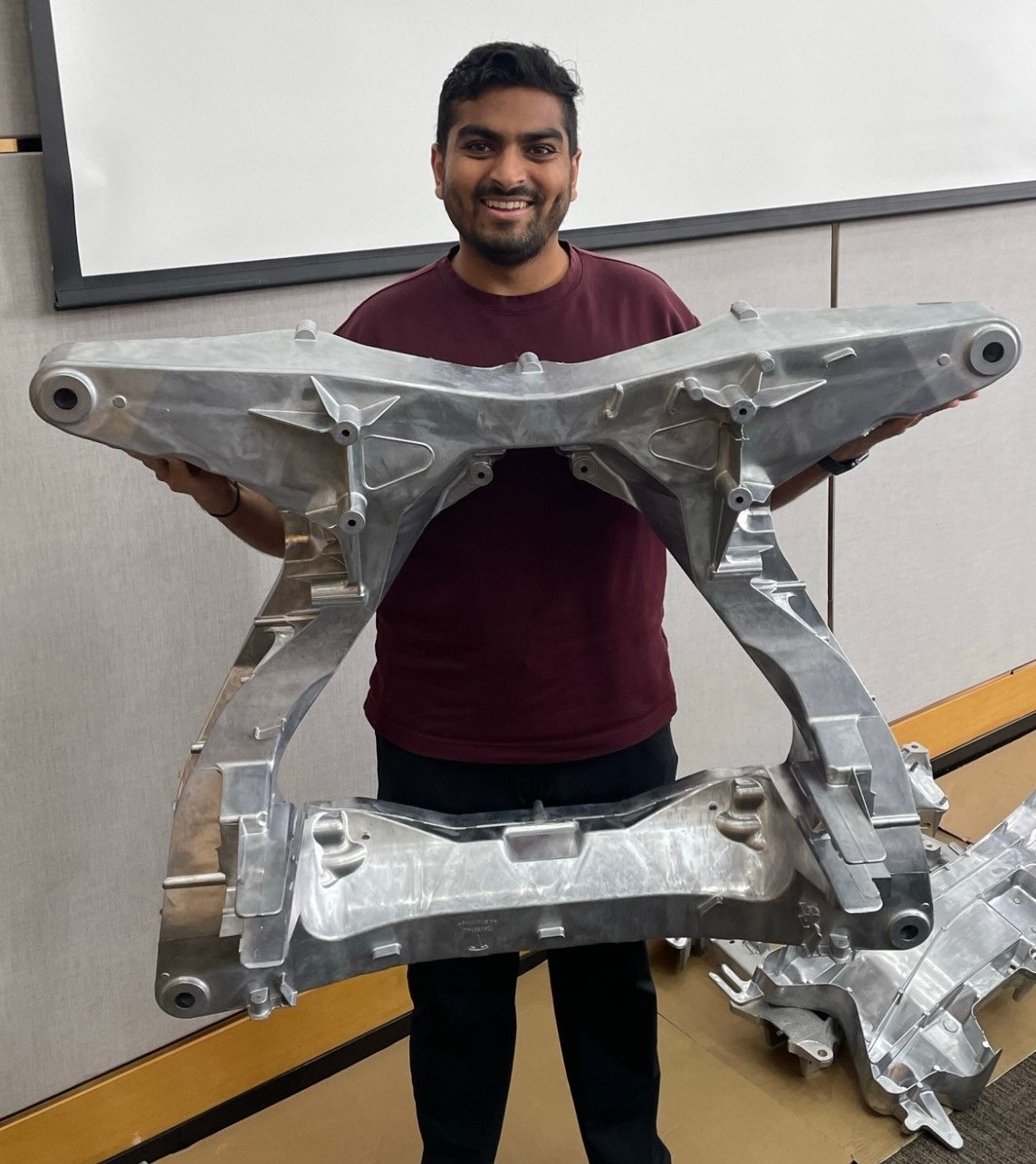
The through-line is vehicle structure under load. I have owned subframes across most of the lineup — the Model 3 launch, Model Y rear suspension, and then the clean-sheet single-piece high-pressure die cast rear subframe for the refreshed Model S and X, the first of its kind in the industry and lighter, cheaper and more durable than what it replaced. That work carried into the one-piece cast rear subframe on Cybertruck, the multi-material front subframe on Cybercab, and structural battery cross members and array barriers. The system-level side of it is the same job seen from further back: strength, durability, crash performance, manufacturability and cost, argued across programs rather than within one.
For the past few years the work has been moving from pure structures toward electromechanical systems. First brake-by-wire integration — electronic brake pedals and hydraulic actuation — and now braking architecture for next-generation platforms, including electromechanical braking, from technology selection through mechanical sizing, supplier development and system integration. Structures taught me how to make something survive; the braking work is where I learned to make something decide.
Earlier
One project from Georgia Tech that still describes how I like to work: a real constraint, a number to hit, and something physical at the end of it.
Formula SAE — steel space frame chassis
I owned the chassis for Georgia Tech Motorsports' 2016 car: a steel space frame with bonded carbon fibre and Nomex honeycomb sandwich panels, six plies laid up 0/30/60/-60/-30/0 to get the panel as close to isotropic as the layup would allow.
The part I still think was the right instinct is that the stiffness target was derived rather than assumed. I built a lateral load transfer model of the car — mass, track, wheelbase, roll centre heights, CG heights, roll stiffness distribution — and swept chassis torsional stiffness until load transfer came within 5% of an infinitely rigid frame. That produced a target of 2,175 lb·ft/deg, and a reason to stop there instead of chasing stiffness at the expense of mass. The car came out at 62 lb complete. Ten years later I am still doing a version of this: pick the number that actually matters, prove where it comes from, then spend mass only up to it.